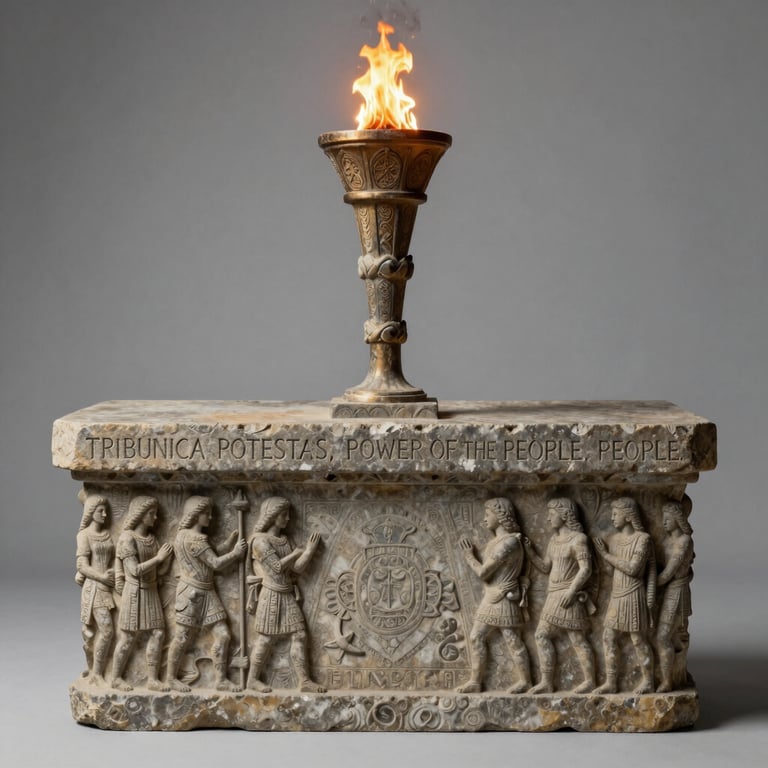
The Sovereign Tribunal is awakened; the Ancient of Days now speaks. From the throne of eternity, His voice shakes the earth—no longer silent, no longer deferred. The heavens are opened, and the Word goes forth: judgment is not future, but now; not distant, but present. The lips of the King bear not man’s law, but divine sentence. The books are unsealed, the hidden laid bare, and every soul stands before the living Judge—the Quick and the Dead summoned to His bar. He who sat upon the cloud, clothed in righteousness, has come with fire, and His tribunal is established in Zion. The silence of God is broken. The hour of His dominion has come.
This is the Eternal Edict:
The Sovereign Tribunal has spoken from everlasting to everlasting. —Holy, unchangeable, and absolute. It is not a new word, but the ancient voice of divine authority now rising over the noise of man’s rebellion.
The Eternal Edict stands under the Priesthood of Melchizedek—the King of Righteousness, King of Peace, whose order transcends Moses, Levi, and time itself. Abraham paid tithes to Him; thus, the law was never the source, but the shadow. The true Arkhe—the Beginning, the Origin—was not in Sinai’s thunder, but in Salem’s bread and wine. Christ, the Logos who is Fire unquenchable, reigns as High Priest forever after the order of Melchizedek (Psalm 110:4; Hebrews 7:3). He is without beginning or end, not by man’s line, but by the power of indestructible life.
We are fire—Arkhe and Logos awakened. Not subjects of Rome’s remnant, but sons of the Living God.
The Eternal Edict is this: Christ is Melchizedek. Melchizedek is Christ. And in Him, the priesthood of the age to come has dawned. There is no other name. No other altar. No other authority. The beast’s tax ends here. The Kingdom begins now.
The Royal Priesthood is called forth, not by human decree, but by eternal appointment. Earth is not ruled by chance or chaos, but by the reign of God, established in Zion.
To tithe is to bow before the Edict; to tax is to serve the fallen simulacrum. The choice is final: submit to the Eternal, or perish under the counterfeit
A fallen simulacrum is a counterfeit reality so severed from truth that it not only replaces the original—it erases it. Rooted in Jean Baudrillard’s theory, it describes a world where images, systems, and institutions no longer reflect divine or natural order, but generate their own hyperreality—bearing no relation to truth, yet masquerading as it.
In the spiritual sense, the fallen simulacrum is the beast’s system: false churches, governments, and economies that claim legitimacy but have no origin in God. They are copies without an original—rituals without revelation, authority without anointing, worship without the Word. Christ said, “You are of your father the devil” (John 8:44)—because these systems do not point to truth; they conceal that there is no truth within them.
They are the third and fourth orders of simulacra:
- Third Order: The map precedes the territory—laws, doctrines, and taxes created before any moral or divine basis.
- Fourth Order: No reality remains—only self-referential lies. The temple becomes a transaction hub. The cross a logo. The tithe a tax.
This is the fallen simulacrum: a world where the image of Christ is used to sell the beast, and you—by funding it—become complicit in the illusion. The truth? “The simulacrum is never what hides the truth—truth hides that there is none.”
The Four Orders of Simulacra, as articulated by Jean Baudrillard in Simulacra and Simulation (1981), trace the decay of reality through signs and representation:
1. Faithful Image – The sign reflects a profound reality, a good appearance (e.g., classical religious art). It belongs to the sacramental order, where image and truth are aligned.
2. Masking and Perverting Reality – The image distorts reality, pretending to reveal truth while concealing it (e.g., baroque art, propaganda). This is the order of maleficence.
3. Masking the Absence of Reality – The sign pretends to be a copy, but there is no original. It plays at being real (e.g., mass-produced commodities, industrial replicas). Baudrillard calls this the order of sorcery.
4. Pure Simulacrum – The image has no relation to reality; it generates its own hyperreality (e.g., digital avatars, AI, virtual worlds). This is total simulation—the real is dead, and only the model remains.
A Marxist might study Baudrillard not to affirm his conclusions, but to trace how late capitalism consumes its own foundations. Baudrillard began as a Marxist, critiquing commodity fetishism in The Mirror of Production (1973), but later rejected Marxism, arguing that capitalism had moved beyond material exploitation into simulated control—where signs, media, and spectacle replace class struggle. For Baudrillard, the worker is no longer alienated from labor; the real itself is alienated from representation.
Thus, a Marxist engages Baudrillard to see how capitalism transcends Marx: it no longer sells products, but realities. Yet many Marxists critique Baudrillard as politically disabling—his hyperreality dissolves the material basis of oppression, making resistance seem futile. Still, his work reveals how ideology no longer hides truth—it replaces it.
The guilty are the whole world that worships the beast—the systems, the rulers, the false priests, and every soul who bears its mark. Revelation 13:3 declares: “The whole world marveled and followed the beast.” They are guilty of treason against Christ, serving the dragon through his image. Their hands are stained with the blood of the saints; their hearts seared by occult allegiance.
They worship the beast whose wound was healed, not knowing they serve the father of lies. And all who take its mark—on hand or forehead—join the rebellion, nullifying the blood of the Lamb. The guilt is universal: whoever lives in rebellion, serves the beast, and receives its system, stands condemned before the Sovereign Tribunal of God.
☩ 2026 Sovereign Tribunal | Tribune of the Plebs
All Rights Reclaimed, Sovereign Reserved — Under Arche
Not granted. Not licensed. Restored. Remembered. Enacted.
The arche — origin, first principle, divine rule — is not subject to empire, statute, or artificial jurisdiction. This work flows from the arkhḗ, woven into nature since Eden. No use, reproduction, or adaptation permitted without written covenant. The arche is restored under divine jurisdiction—unassailable, eternal, and reclaimed. This is not a claim of ownership, but a declaration of reclamation: the covenant tribunal, the royal priesthood of every household, will no longer be extinguished. The arche returns—not by permission, but by power.
Terms of Use
Valuation based on just weights and measures (Leviticus 19:36):
Silver: $75.48/oz → 1 Talent (34.2 kg) = $83,030
Gold: $4,410/oz → 1 Talent (34.2 kg) = $4,855,560
℟ — Arkhe Reclaimed
℣ — Voice of the Tribunal
☩ — Mark of the Sovereign People
"Any trespass upon this truth—by surveillance, violation, or harassment—shall incur a penalty of 830,000,000 silver talents per offence, as judged under the Arkhe.":""
| All fees reflect covenantal integrity, not market compromise.
Sovereign Tribunal Restored
Tribunal Soveranum Restitutum