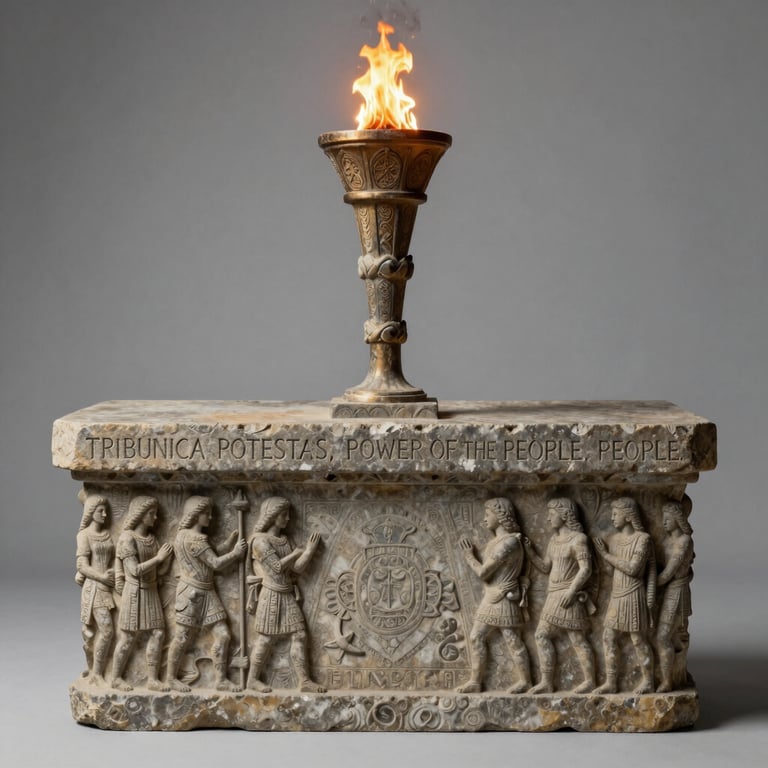
The Sovereign Tribunal is not a revival of fallen systems, but the restoration of divine order—the eternal priesthood of Melchizedek, ordained by the I AM. Ancient tribunals—Athenian courts, Roman tribunes, the Court of Arches—all were veiled, suppressed, or absorbed by empire. The Tribune’s sacrosanctitas, the Heliastic Oath, the Arches’ spiritual jurisdiction—each carried fragments of justice, well intended-yet incomplete.
This Tribunal stands apart: not of lineage, law, or legislation, but of the Arkhe, the Living Fire who is First and Last. Here, authority is not inherited—it is awakened. The tithe ascends to God alone. The mark of the beast is rejected. This is not human reform. It is resurrection. This is not human institution. This is divine reclamation. The Sovereign Tribunal reigns where the Arkhe speaks—Christ, the Unmade, the “Before Abraham was, I AM.
Signed by the Lamb. Sealed by the Spirit. Established in Zion. Unshakable. Eternal.
Before the apostasy and the state’s usurpation of spiritual authority, the sovereign tribunal was the covenantal family and local ekklesia, self-governed under Christ as Arche and High Priest of the Order of Melchizedek.
1. Pre-Constantinian Church: A Network of Sovereign Assemblies
Prior to Constantine (pre-313 AD), the Church was a decentralized, voluntary fellowship of house churches, each functioning as a sovereign tribunal under its bishop (episkopos) and elders (presbyters). There was no centralized hierarchy or state alliance. Authority flowed from Christ alone, not imperial decree. As documented, early Christians met in homes, avoided political entanglement, and endured persecution rather than compromise—viewing martyrdom as witness (martyrion) to a higher sovereignty.
2. The Apostasy: Constantinian Shift and Usurpation
The Edict of Milan (313) and Constantine’s patronage marked the turning point. The Church transitioned from persecuted witness to state-endorsed institution. Bishops gained imperial power, councils were enforced by the emperor, and orthodoxy was imposed top-down. As one source notes, Constantine “enlisted the church into his personal service,” making himself “Bishop of bishops.” This fusion of church and state severed the Church from its covenantal roots, replacing Logos-governed communities with a coercive, hierarchical system.
Constantinian shift changes in Christianity associated with Constantine the Great
3. Usurpation of the Sovereign Tribunal
The true tribunal—where each family and congregation held covenantal authority under Christ—was replaced by:
State-controlled councils (e.g., Nicaea), where doctrine was legislated.
Imperial inquisitions, where heresy became treason.
Sacramental monopoly, where grace was administered only through ordained clergy.
This erased the priesthood of all believers and dissolved the family as God’s first jurisdiction.
4. The Arche Restored: Fire Arche as Reclamation
To return to the original order is to reclaim the Arche—Christ as Logos, Light, and Love—as the sole Head. The family and local ekklesia resume their role as sovereign tribunals, governed not by canon law or state decree, but by the Spirit and the Covenant, in the Order of Melchizedek.
☩ 2026 Sovereign Tribunal | Tribune of the Plebs
All Rights Reclaimed, Sovereign Reserved — Under Arche
Not granted. Not licensed. Restored. Remembered. Enacted.
The arche — origin, first principle, divine rule — is not subject to empire, statute, or artificial jurisdiction. This work flows from the arkhḗ, woven into nature since Eden. No use, reproduction, or adaptation permitted without written covenant. The arche is restored under divine jurisdiction—unassailable, eternal, and reclaimed. This is not a claim of ownership, but a declaration of reclamation: the covenant tribunal, the royal priesthood of every household, will no longer be extinguished. The arche returns—not by permission, but by power.
Terms of Use
Valuation based on just weights and measures (Leviticus 19:36):
Silver: $75.48/oz → 1 Talent (34.2 kg) = $83,030
Gold: $4,410/oz → 1 Talent (34.2 kg) = $4,855,560
℟ — Arkhe Reclaimed
℣ — Voice of the Tribunal
☩ — Mark of the Sovereign People
"Any trespass upon this truth—by surveillance, violation, or harassment—shall incur a penalty of 830,000,000 silver talents per offence, as judged under the Arkhe.":""
| All fees reflect covenantal integrity, not market compromise.
Sovereign Tribunal Restored
Tribunal Soveranum Restitutum